

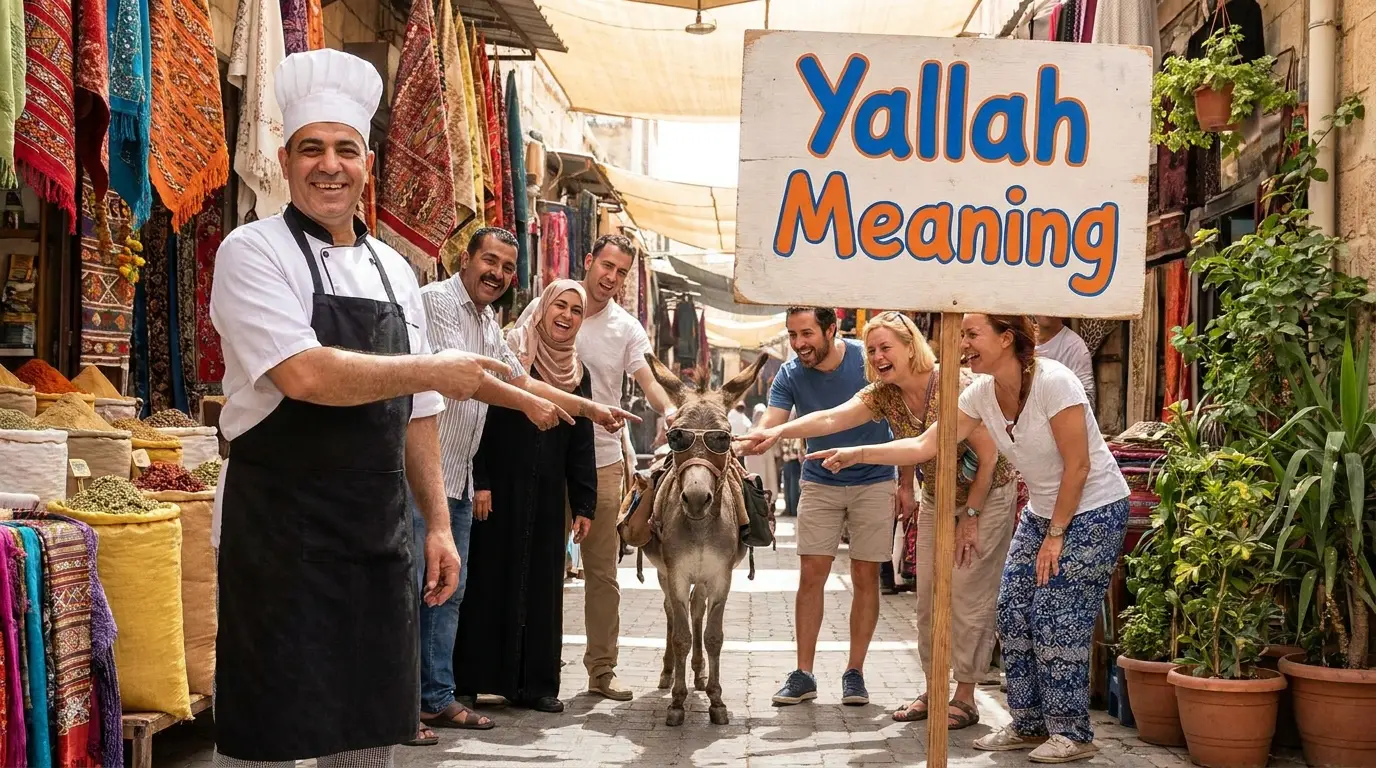
Have you ever received a message that says “Yallah, let’s go!” and wondered what it means? The phrase yallah meaning is a popular search because people often see this word in text messages, social media comments, videos, and everyday conversations. Yallah is commonly used in Arabic to tell someone to hurry up, come on, or get moving. Depending on the situation, it can also express excitement, encouragement, or a friendly push to do something. You might hear it in conversations with friends, in Arabic songs, or in viral TikTok videos. Understanding this expression can help you follow online conversations and communicate more naturally with people from different cultures. In this guide, you will learn what yallah means, where it comes from, how people use it on social media, and how to reply when someone says it to you.
What Does Yallah Mean in Texting?
Yallah means “let’s go,” “come on,” or “hurry up.” It is an Arabic expression used to encourage someone to move, start an activity, or do something without waiting too long.
The exact meaning depends on the conversation. Sometimes, it sounds friendly and exciting. In other situations, it can express impatience.
Here are some common meanings of yallah:
- Let’s go: Encouraging someone to leave or start moving.
- Hurry up: Asking someone not to waste time.
- Come on: Encouraging someone to take action.
- Let’s do it: Showing excitement about an activity.
- Get moving: Telling someone to start doing something.
For example:
Friend 1: Are you ready for the party?
Friend 2: Yes! Yallah!
In this conversation, yallah means “Let’s go!” It shows that the second person is ready and excited.
Yallah Meaning in One Line
Yallah is an Arabic expression that means “let’s go,” “come on,” or “hurry up,” depending on the context.
What Is the Full Form of Yallah?
Yallah does not have a full form like internet abbreviations such as LOL or BRB. Instead, it is a word or expression derived from Arabic.
It is commonly written as يلا in Arabic script. You may also see it spelled yalla, yallah, or yallaah in English letters.
The Arabic expression is often explained as a shortened form of “ya Allah,” meaning “O Allah.” However, in everyday conversation, yallah is generally understood as an expression encouraging someone to move, begin, or continue an activity.
Origin and History of Yallah
Yallah comes from Arabic and has been used in everyday conversations across Arabic-speaking communities for generations.
People use it when they want someone to start moving, leave a place, hurry up, or take action. It is a natural part of casual communication rather than a word created specifically for the internet.
The expression is widely recognized in different Arabic-speaking countries, although pronunciation, tone, and local usage can vary.
How Did Yallah Become Popular Online?
Yallah became familiar to many people outside Arabic-speaking communities through music, films, television, travel, and conversations with Arabic speakers.
Social media has helped spread the expression even further. Creators use it in short videos, captions, jokes, and reaction clips because it is short, expressive, and easy to understand from context.
Its popularity is also connected to the growing global influence of Arabic music and online creators.
Today, people may use yallah even when the rest of their conversation is in English. This is especially common in multilingual communities and among people who enjoy borrowing expressions from other languages.
How Is Yallah Used in Text Messages?
In texting, yallah usually encourages someone to do something or signals that it is time to begin.
The expression is flexible, so the same word can communicate different feelings depending on the situation.
1. When You Want Someone to Hurry Up
Friends often use yallah when someone is taking too long.
Example:
Friend: I’m still getting ready.
You: Yallah, we’re already late!
Here, yallah means “Hurry up!” The message sounds casual and may be playful between friends.
2. When You Are Ready to Leave
You can use yallah when it is time to go somewhere.
Example:
A: Is everyone ready to leave?
B: Yallah, let’s go!
In this example, the word encourages everyone to start moving.
3. When You Want to Encourage Someone
Yallah can also motivate someone to begin a task or make a decision.
Example:
Friend: I don’t know if I should join the game.
You: Yallah, give it a try!
The meaning here is similar to “Come on, try it!”
4. When You Are Excited
Sometimes, yallah expresses enthusiasm rather than impatience.
Example:
A: Our favorite singer is coming on stage!
B: Yallah! This is going to be amazing!
In this situation, the word adds excitement to the conversation.
Yallah Meaning on WhatsApp
On WhatsApp, yallah is commonly used in private messages, family groups, and conversations with friends.
Its meaning depends on what the people are discussing.
Common WhatsApp examples include:
- “Yallah, call me when you’re free.”
- “Yallah, we’re waiting outside.”
- “Yallah, let’s order some food.”
- “Yallah, finish your work first.”
- “Yallah, see you tomorrow!”
In these messages, the expression encourages action, suggests moving forward, or signals that it is time to do something.
The tone can be friendly, playful, or slightly impatient.
For example, “Yallah, we’re waiting!” may sound like a lighthearted reminder among friends. However, if someone is upset, the same expression might sound more forceful.
Tip: Always consider your relationship with the sender and the rest of the message before deciding how they mean it.
Yallah Meaning on Instagram
On Instagram, people may use yallah in comments, direct messages, captions, and Stories.
It can express excitement, encourage someone to take action, or react to a plan.
Here are some examples:
- “Yallah, let’s make this trip happen!”
- “Yallah, post the pictures already!”
- “Yallah, this outfit is everything!”
- “Yallah, we’re going out tonight!”
- “Yallah, drop the new video!”
The expression can also appear in comments on travel pictures, party videos, and posts about exciting plans.
For example, if someone shares a picture of a group getting ready for a trip, a friend might comment, “Yallah, adventure time!”
In this case, the word communicates enthusiasm and readiness.
Yallah Meaning on TikTok
On TikTok, yallah may appear in videos, captions, voiceovers, and comments.
Its meaning usually stays close to “let’s go,” “come on,” or “hurry up.” However, the delivery can make it sound funny, dramatic, excited, or impatient.
For example:
TikTok caption: “Me telling my friends to get ready for the trip: Yallah, let’s go!”
Another example might be a creator using the expression when encouraging someone to try a challenge.
People may also hear yallah in Arabic music, comedy clips, and videos featuring multilingual conversations.
Why Do People Use Yallah in TikTok Videos?
There are several reasons the expression works well in short videos:
- It is short and easy to say.
- Its meaning is often clear from context.
- It adds energy to a sentence.
- It works in funny and everyday situations.
- It is recognizable to many Arabic speakers.
However, not every appearance of yallah represents a new slang trend. It is an established Arabic expression that social media has helped introduce to wider audiences.
Yallah Meaning on Snapchat
On Snapchat, yallah can be used in quick chats, Snaps, and conversations about making plans.
Because Snapchat messages are often casual, the expression can fit naturally into short exchanges.
Here are a few examples:
Example 1
Friend: Are you coming?
You: Yallah, I’m on my way!
Example 2
Friend: We’re outside your house.
You: Yallah, give me two minutes!
Example 3
Friend: Let’s get something to eat.
You: Yallah, I’m hungry!
In each example, the expression encourages movement or shows readiness.
It does not have a special Snapchat-only meaning. Its meaning remains connected to its everyday Arabic usage.
Different Meanings of Yallah Depending on Context
Although yallah is commonly translated as “let’s go,” it can communicate several related ideas.
Understanding the situation helps you interpret it correctly.
| Situation | Possible meaning | Example |
|---|---|---|
| Leaving a place | Let’s go | “Yallah, we’re leaving.” |
| Waiting for a friend | Hurry up | “Yallah, get ready!” |
| Starting a task | Come on | “Yallah, start studying.” |
| Encouraging someone | Go for it | “Yallah, you can do it!” |
| Expressing excitement | Let’s do this | “Yallah, it’s party time!” |
| Ending a conversation | Let’s move on or go | “Okay, yallah, see you later.” |
These meanings are closely related, but the exact interpretation depends on the speaker’s intention.
For example, a person saying “Yallah!” with an excited voice may be expressing enthusiasm. Someone saying it impatiently may be asking others to hurry.
Common Misunderstandings About Yallah
People who are unfamiliar with Arabic may misunderstand the expression when they first encounter it online.
Here are a few important points to remember.
1. Yallah Is Not an Internet Acronym
Some slang expressions are abbreviations made from the first letters of several words.
Yallah is different. It is an established Arabic expression, not an acronym with a separate English full form.
2. Yallah Does Not Always Mean Hurry Up
Although it can mean “hurry up,” it can also mean “let’s go,” “come on,” or “let’s do it.”
The situation and tone help determine the intended meaning.
3. Yallah Is Not Automatically Rude
The word is not inherently rude or offensive. Friends and family members often use it naturally.
However, a forceful tone can make it sound impatient, just as “Come on!” can sound friendly or annoyed in English.
4. Yallah Does Not Have a Special TikTok Definition
Social media has helped spread the word, but it has not replaced its basic meaning.
If you see yallah in a TikTok caption, you can usually understand it by considering the surrounding words and video.
5. Yallah Is Different From ASL
The expression yallah should not be confused with ASL, which can mean different things depending on the context.
ASL commonly stands for American Sign Language. In some informal internet conversations, it has also been used as an abbreviation for “age, sex, location.”
These meanings are unrelated to yallah.
The two expressions have different origins, spellings, and uses.
Similar Slang Words and Alternatives to Yallah
If you understand yallah, you may also want to learn other expressions that communicate similar ideas.
Some are English phrases, while others come from different languages.
| Word or phrase | Meaning | Example |
|---|---|---|
| Let’s go | Start moving or begin | “Let’s go to the mall.” |
| Come on | Encourage someone to act | “Come on, join us!” |
| Hurry up | Move faster | “Hurry up, we’re late.” |
| Let’s do this | Show readiness or excitement | “Let’s do this!” |
| Go for it | Encourage someone to try | “Go for it, you can win.” |
| Vamos | Spanish for “let’s go” | “Vamos, team!” |
| C’mon | Informal form of “come on” | “C’mon, we’re ready.” |
| ASAP | As soon as possible | “Send it ASAP.” |
These expressions are not perfect replacements in every situation, but they can communicate similar ideas.
For example, “Hurry up!” is more direct than “Let’s go!” Meanwhile, “Go for it!” focuses more on encouragement than movement.
How to Reply When Someone Says Yallah
Your response depends on what the other person means.
They might be asking you to leave, encouraging you to start something, or expressing excitement.
Here are some natural replies you can use in different situations.
1. Casual Replies
Use these responses when talking to friends or family.
- “Coming!”
- “Let’s go!”
- “I’m ready!”
- “Give me a minute.”
- “Okay, let’s do it!”
- “I’m on my way!”
Example:
Friend: Yallah, we’re leaving!
You: Coming! Just give me a minute.
2. Funny Replies
If the conversation is playful, you can respond with a little humor.
- “Relax, I’m not a rocket!”
- “Yallah yourself!”
- “Wait for me!”
- “I’m moving at full speed!”
- “Already coming!”
Example:
Friend: Yallah, hurry up!
You: I’m coming! My shoes are still loading.
These responses work best when you know the other person will understand your joke.
3. Polite Replies
If you want to sound respectful, especially when talking to someone you do not know well, try these responses.
- “Sure, let’s go.”
- “Of course, I’m ready.”
- “Okay, I’ll be there soon.”
- “Just a moment, please.”
- “Thanks for waiting.”
Example:
Colleague: Yallah, we need to start the meeting.
You: Of course. I’ll be ready in a moment.
4. Flirty Replies
When you are chatting with someone you like, you can respond playfully if the conversation already has a flirty tone.
- “Only if you’re coming with me.”
- “Okay, but you have to wait for me.”
- “Lead the way!”
- “I’m ready if you’re ready.”
- “You first, then I’ll follow.”
Example:
Person you like: Yallah, let’s go!
You: Only if you’re coming with me 😉
Use these responses when they fit your relationship and the other person’s tone. You do not need to flirt just because someone uses the word.
5. Boundary-Respecting Replies
Sometimes, someone may use yallah to pressure you into doing something before you are ready.
You can respond politely while making your boundaries clear.
- “Give me a little more time, please.”
- “I’m not ready yet.”
- “I’ll join when I can.”
- “Please don’t rush me.”
- “I need a moment to decide.”
Example:
Friend: Yallah, just do it!
You: Give me a moment. I want to think about it first.
Remember, you can understand someone’s expression without agreeing to everything they suggest.
Is Yallah Still Popular in 2026?
Yallah remains a recognizable expression in Arabic-speaking communities and among people who encounter Arabic through music, entertainment, travel, and social media.
It continues to appear in everyday conversations and online content because it is short, expressive, and easy to use.
However, it is important to distinguish between an established language expression and a temporary internet trend. Yallah existed long before TikTok and other modern platforms became popular.
Its appearance in social media content does not necessarily mean that it has recently become popular everywhere.
Among younger internet users, expressions from different languages can become familiar through songs, creators, and online friendships. Yallah fits naturally into this broader pattern of multilingual communication.
Its exact popularity varies by region, community, and platform.
People Also Ask: Yallah Meaning FAQs
1. What does yallah mean in texting?
Yallah means “let’s go,” “come on,” or “hurry up.” People use it in text messages to encourage someone to move or start an activity.
2. What is the full form of yallah?
Yallah does not have an English full form because it is not an acronym. It is an Arabic expression commonly written as يلا.
3. What does yallah mean in Arabic?
In Arabic, yallah is a common expression used to encourage action, suggest leaving, or tell someone to hurry up. Its precise meaning depends on context.
4. What does yallah mean on TikTok?
On TikTok, yallah generally means “let’s go,” “come on,” or “hurry up.” It may appear in captions, comments, videos, and conversations.
5. Is yallah a rude word?
No, yallah is not inherently rude. It can sound friendly, excited, or impatient depending on the situation and the speaker’s tone.
6. What is the difference between yalla and yallah?
Yalla and yallah are common English-letter spellings of the same Arabic expression. Both are generally used to mean “let’s go” or “come on.”
7. How should I reply when someone says yallah?
You can reply with “Let’s go,” “I’m ready,” or “Coming!” If you need more time, say “Give me a minute, please.” Choose a response that fits the conversation.
Conclusion
The meaning of yallah is simple once you understand its Arabic origins and everyday use. It generally means “let’s go,” “come on,” or “hurry up,” depending on the context. You may encounter it in WhatsApp messages, Instagram comments, TikTok videos, Snapchat chats, and everyday conversations. Although it is widely used online, yallah is an established Arabic expression rather than a newly invented internet abbreviation. When someone says it to you, consider the situation and choose a natural response, whether that is “Let’s go,” “Coming!” or “Give me a minute.” Understanding this expression makes online conversations across cultures easier to follow.
